This post was originally published as part of Loomis Chaffee’s Monday Musings newsletter…
In December of last year, we welcomed over 80 colleagues from peer schools onto campus for our second symposium on AI in the classroom. The presentations – many done by our colleagues – were rich and informative and provided a lot of food for thought. Coming out of the symposium, I realized that across schools many teachers are excited by the promise that integrating AI into their classroom could bring but feeling unprepared or nervous about beginning. What follows is an attempt to take what I learned from the symposium and filter it through that lens, ultimately providing an answer (of many possible answers) to the question: “Where should I begin?”
Learn the basics of the tools.
Many schools talked about PD to get teachers started. Both Bard and ChatGPT are designed for tinkering. That may be the best way to start! One key point: be persistent. Ask for more detail if the response is lacking. Change your prompt to get it right, try again. Push it to provide more detail, or in the case of Bard or GPT4, to cite its sources. (Yes, it can do that!)
If you’re looking for some teacher-specific guides, here are two great places to start, both from Wharton Professors Ethan and Lilach Mollick:
Wharton Interactive Crash Course: Introduction to AI for Teachers and Students
In this five-part course, Wharton Interactive’s Faculty Director Ethan Mollick and Director of Pedagogy Lilach Mollick provide an overview of AI large language models for educators and students. They take a practical approach and explore how the models work, and how to work effectively with each model, weaving in your own expertise. They also show how to use AI to make teaching easier and more effective, with example prompts and guidelines, as well as how students can use AI to improve their learning.
Harvard Business Publishing: An Inspiring Minds Series – Student Use Cases for AI
To help you explore some of the ways students can use this disruptive new technology to improve their learning—while making your job easier and more effective—we’ve written a series of articles that examine the following student use cases:
AI as feedback generator
AI as personal tutor
AI as team coach
AI as learner
Pick your spots.
Nick Zufelt, a CS teacher at Phillips Academy Andover led a workshop about using ChatGPT to support, not supplant student thinking. One of his overarching suggestions: be honest about where your students need feedback or support and you’re unable to provide it sufficiently (think: all your students want feedback on a thesis statement…at the same time!). He made the case in this instance (and many others) that AI can support teachers and students effectively.
Another way of thinking about where to use it in your curriculum is by borrowing the Impact-Feasibility Matrix framework, and instead adapting it to how you’re thinking about the tool in your classroom. For example, you might think about the way that a given use of AI might impact the course design or experience for your students vs. how much time it might save you in prep and planning, as I have done here:
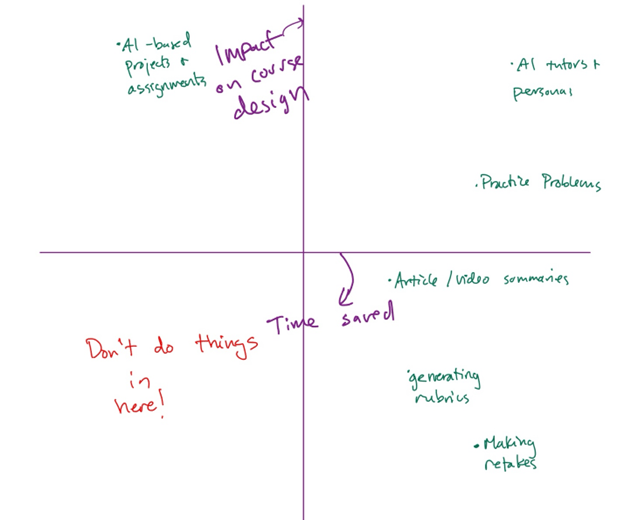
In general, it might make the most sense to start in the 2nd quadrant, where there are minimal disruptions to the course design but lots of time saved for the teacher.
Other ways to build this matrix could be Ease of Implementation vs. Student Learning or How Important the task is for student learning vs. time it takes for student to complete the task. Obviously, these plots are not written in stone; simply a way to lend some structure to brainstorming.
Tinker, iterate, share.
One of my biggest takeaways from the symposium is simply that sharing ideas about teaching with a group of teachers is motivating and inspiring. Not only because of the fresh ideas I learn from others, but also because those insights sharpen ideas or practices I already have in place.
Integrating these models into your classroom can feel like a big change: a totally new, powerful technology that we haven’t really had time to react to or contemplate the best ways to use it. Our first crack at doing so is more than likely to fail. I think that’s OK. When I first designed an assignment using ChatGPT in the writing process for a senior elective in English, it fell flat on its face – most students didn’t engage with the tool productively, nor were their final products much better than they would have been otherwise. But, learning from colleagues, doing more reading and research on my own, and trying again produced more polished, refined, and effective approaches to using the tool in that same context.
Engage your students.
Finally, a good place to begin might be asking your students if they have any thoughts, ideas, or wonderings about how AI could be useful in their learning. Many students are confused about the tool – they can’t imagine uses for it beyond simply copying and pasting their homework assignments into it and getting ‘answers’. For many, it’s solely a entry point to academic dishonesty. It need not be that way. Indeed, it has many upsides. Helping our students understand both the pros and cons of the technology, while also providing learning experiences to demonstrate both will both help them learn more effectively and also push them to be more critical consumers of technology.
 {teaching bits}
Leave a comment